



Blue Machine,
New Drivers.
Two farewells, one election, and a new chapter for South Africa's second-largest political party — a full account of the DA's most consequential Federal Congress in its history.
The Stage Was Already Set Before Anyone Spoke
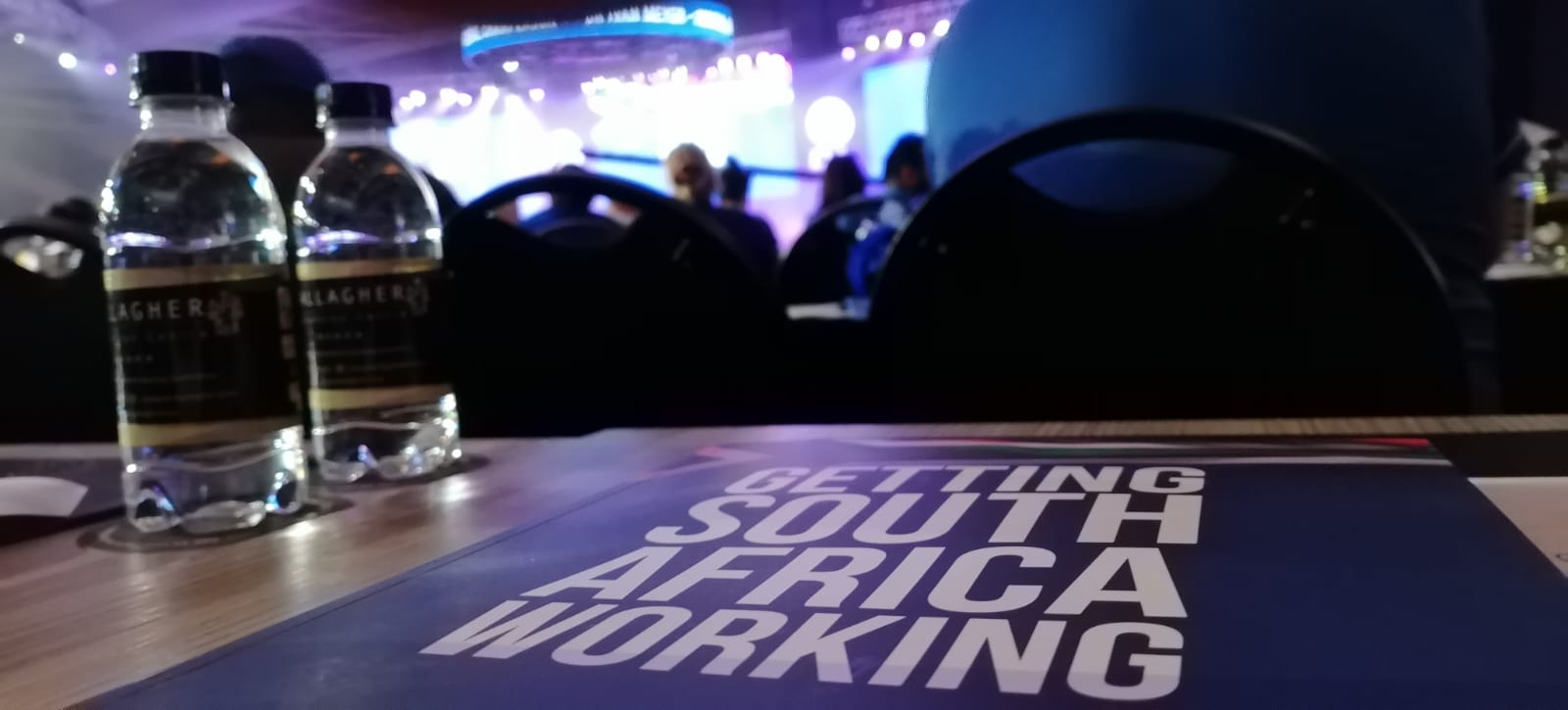
More than 2,000 delegates filled the Gallagher Convention Centre in Midrand this weekend for what the DA itself described as the largest Federal Congress in the party's history. They came to do something the party has never done at this scale before — replace its two most dominant figures simultaneously, elect an entirely new leadership team, and walk back out into a South Africa that is watching more closely than usual.
This was not a routine congress. John Steenhuisen announced in February that he would not seek a third term as Federal Leader. Helen Zille declined to run for re-election as Federal Council Chairperson. Dion George had already resigned from the party in January following a bruising public fallout with Steenhuisen over his removal as Minister of Forestry, Fisheries and the Environment. The federal finance chair position was sitting vacant. In a single season, the DA had to replace the architecture of its entire national leadership — and it chose to do so under the full glare of public scrutiny, with electronic voting, private cubicles, and verifiable results.
Two candidates stood for the top job. Cape Town Mayor Geordin Hill-Lewis — widely expected to win, backed by establishment figures including Zille herself, and running on the strength of Cape Town's governance record. And Sedibeng caucus leader Sibusiso Dyonase — largely unknown nationally, who entered the race just two days before nominations closed, organised Zoom calls with provincial members because he couldn't afford to travel, and ran on conscience alone. He told delegates the election was not a popularity contest. He was right. And the party gave him a proper platform to say so.
Two Farewells, One Flame
Helen Zille and John Steenhuisen both walked off the same stage on Saturday — and neither of them looked like they were losing.
Zille went first. If you expected sentiment, you didn't get it. She opened with 1959 — not the party's rebranding, not the 2024 election, not even the GNU. She went back to Dr Jannie Steytler and the founding of the Progressive Party, to Helen Suzman standing alone in Parliament against apartheid, to the argument that liberal democracy has historically taken root in homogenous societies and cracked the moment those societies diversify. The DA, she said, is the rare experiment that proved the opposite. A liberal movement that grew in arguably the most complex, historically fractured society on earth.
"One day South Africa will be governed by our principles — because it is the only way it can be governed."— Dr Jannie Steytler, 1959. Quoted by both Helen Zille and John Steenhuisen in their farewell addresses.
She didn't dress it up. She named the global retreat from liberal values for what it is. And she said the DA has remained "unbent and unbowed" while much of the world capitulated to identity politics, ethno-populism, and the weaponisation of diversity. Bold claim. Not an empty one.
Then Steenhuisen took the floor. He came in with receipts. He inherited a party polling at 16 percent in 2019 — divided, written off by the media, on its knees. He leaves it polling close to 30 percent, sitting inside the Government of National Unity, managing portfolios that touch millions of South African lives daily. Agriculture. Home Affairs. Basic Education. Public Works. Communications. He went through every one. The removal from the FATF grey list. The first credit rating upgrade in 20 years. The blocking of the VAT increase. The court challenge to the Expropriation Act — which, he noted with visible satisfaction, led the President himself to concede in his own court papers that the Act is unconstitutional.
He called it the Moonshot mission. And by any honest measure, they pulled it off.
What struck this reporter — sitting with both speeches side by side — is what both leaders chose to end on. Not policy. Not polling. Both of them quoted Jannie Steytler. That is not coincidence. That is a deliberate handover of a flame, from one generation to the next, with a 67-year-old promise still burning at the centre of it.
The Vote
Sunday morning, 2,000 delegates went into private cubicles with laptops and cast their ballots electronically. The results were announced in the afternoon. No drama. No bribery allegations. No factionalist chaos. Just a party conducting its internal democracy the way it tells the rest of the country democracy should work.
🎉 Geordin Hill-Lewis — elected Federal Leader of the Democratic Alliance.
It was the expected outcome, but the margin matters less than the mandate. Hill-Lewis inherits a party that is numerically stronger than at any point in its history, structurally complex, and facing the most difficult political balancing act of its existence — governing from inside the GNU while positioning itself as the credible alternative to the ANC by 2029.
🎉 Solly Msimanga — elected Federal Chairperson, defeating incumbent Ivan Meyer.
Msimanga's win is the more interesting result of the weekend. He beat an incumbent. He ran explicitly on rebuilding the DA's collapsed grassroots structures in Gauteng — the province where the exodus of black leaders between 2019 and 2023 left gaping holes the party has been trying to fill ever since. He has been here before: he ran for a similar position in 2018 and lost. He came back. The delegates noticed.
🎉 Siviwe Gwarube · Cilliers Brink · Solly Malatsi — elected Deputy Federal Chairpersons.
Three deputies. Three different profiles. Gwarube — the Basic Education Minister — ran on a single argument: only a growing DA can deliver a growing South Africa. Brink, the former Tshwane mayor, made unity his pitch. Malatsi, seeking re-election, told delegates the work isn't done. All three align closely with the Hill-Lewis vision. This is not a fractured leadership team. It is a bloc with a shared direction, elected by delegates who made a deliberate generational choice.
"Strong Enough to Win" — What Hill-Lewis Said Next
The acceptance speech was not triumphalist. It was methodical. Hill-Lewis began with his family — his wife Carla, his daughter watching at home, his late father who had once handed him a newspaper job advert for the SA Post Office with a handwritten note suggesting he apply rather than go into politics. He told that story to Solly Malatsi directly. It landed in the room.
He then did something that recent DA leaders have occasionally neglected — he spent genuine time honouring the people who came before him. Tony Leon, who built a fearless opposition from 1.7% of the national vote and proved that principled opposition is never unpatriotic. Helen Zille, who transformed the party from opposition to governing force, and whom Hill-Lewis first met as a schoolboy at a DA Youth meeting in Bonteheuwel in 2004. Mmusi Maimane, whose ability to connect across communities reminded the party that politics is about people. And Steenhuisen, who led the DA into national government for the first time in its history.
It was a long walk through history. And it was deliberate. Hill-Lewis was establishing that he is not breaking with what came before — he is building on it. The argument of continuity, made with specificity rather than vague deference.
"We spent years building a party that could be a strong opposition. Then we built a party that could govern. Now we must build the biggest party in South Africa — a party that is strong enough to win."— Geordin Hill-Lewis, Acceptance Speech, DA Federal Congress 2026
Then came the substance. Hill-Lewis laid out four things the DA must do to win the next chapter:
His single stated national policy priority was crime. Not framed as a policy area among many — framed as the one crisis that holds every other crisis hostage. He spoke about the fear that South Africans wake up with every morning. The woman who knows she is a target. The elderly person who double-locks the door. The farmer who knows help is hours away. And then, sharply, the criminals and syndicates who have no fear at all — because they have learned that in South Africa, there are no consequences.
It was a direct pitch for voters who have not trusted the DA before, particularly in communities where violent crime is not a statistic but a daily reality. Whether the DA can operationalise that pitch into credible policing reform — especially from inside a GNU it does not control — is the real question. Hill-Lewis knows it. He said it explicitly: law and order is not one priority among many. It is the priority.
What the Blue Machine Does Next
Hill-Lewis confirmed he will stay in Cape Town as Mayor rather than taking a seat in the National Assembly. That is a studied choice. It keeps distance between him and the cabinet — room to criticise the President's decisions without being bound by collective responsibility. It gives the DA a governing showcase that isn't dependent on coalition arithmetic. And it protects him from the daily compromises of GNU membership eroding his credibility as a party leader with national ambitions.
Smart. But it also comes with a cost. Governing the country and building a national party require different kinds of daily presence. He cannot be everywhere. The new deputies will carry significant weight. Msimanga will need to actually rebuild Gauteng's collapsed structures — not just in speech, but in branches, councillors, and vote percentages. Gwarube will need to convert her parliamentary profile into real community trust. Malatsi's work in digital access and communications will need to show tangible results before 2026 local government elections hit.
The road from Midrand runs directly into those elections. Joburg. Tshwane. Ekurhuleni. Nelson Mandela Bay. Durban. Hill-Lewis named them all in his speech. He wants them. The question is whether a freshly elected leadership team can translate a clean internal democratic process into actual ballot box growth — in provinces and communities that still regard the DA with deep suspicion, and where the ANC's decline has not automatically translated into DA momentum.
The Doomsday Coalition holds Gauteng. Ethnic nationalism is growing. The populist tide is rising at precisely the moment the DA has reached its highest point of national influence. The blue machine has new drivers. South Africa is watching where they take it.